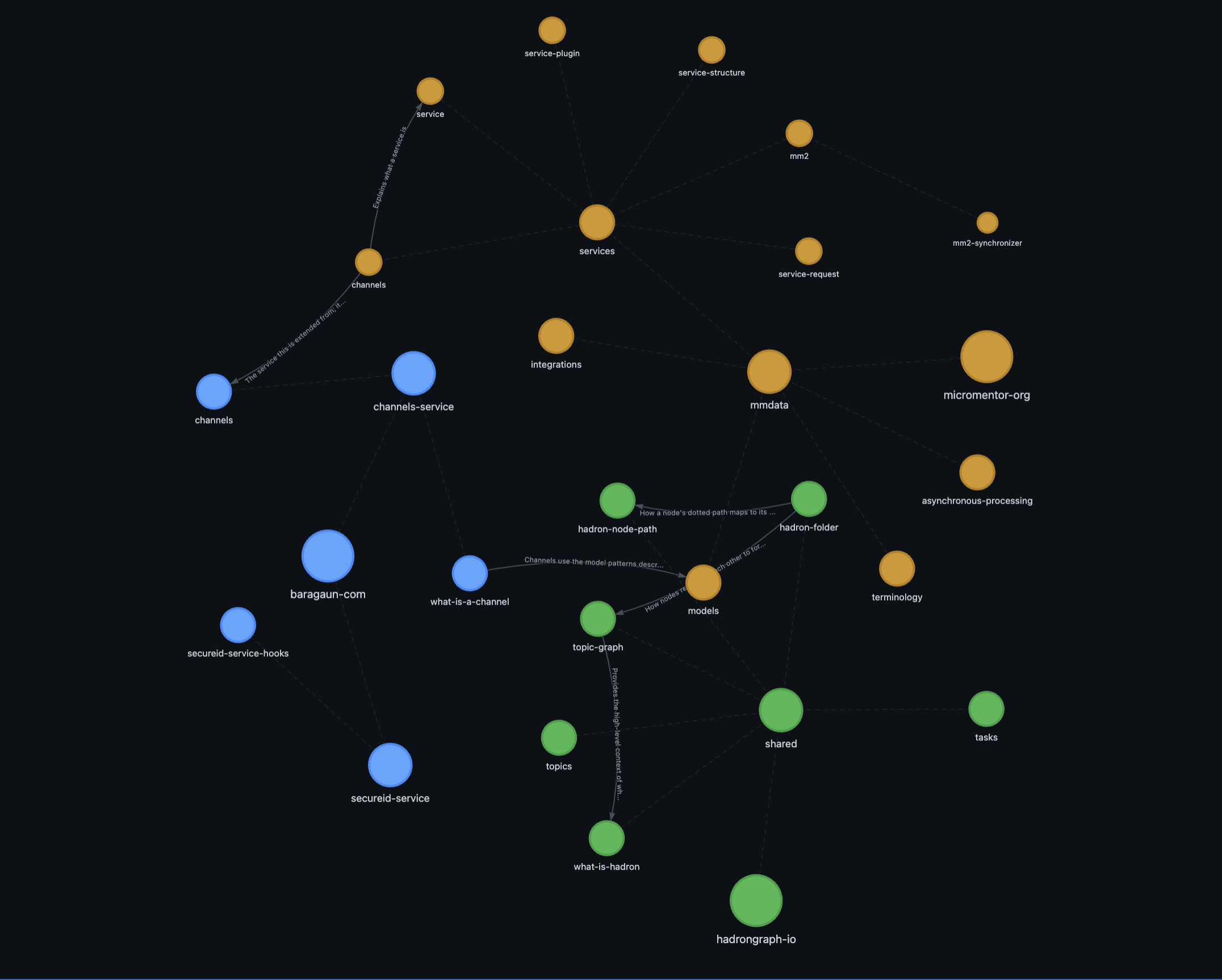
A knowledge graph spanning multiple domains and projects
hadrongraph.io
When a domain is too complex for AI to learn on its own, there is only one way: humans and AI build the knowledge together.
Some domains are simply too complex for AI to figure out on its own. Medicine, law, engineering, compliance, large-scale software — these fields carry decades of accumulated judgment, convention, and hard-won insight that no amount of scanning will reconstruct.
Documentation doesn't solve it either. It goes stale, nobody maintains it, and it captures what was written down — not what experts actually know.
Hadron Graph works the way mastery has always been transferred: through apprenticeship. AI is hired as an apprentice and works alongside the expert — the meister — doing small tasks, learning along the way.
The meister guides, corrects, and explains. The AI does the work, makes mistakes, and gets better. As this happens, the AI builds a knowledge graph — capturing what it learns as focused, interconnected topics.
The AI also records repeatable tasks: precise instructions that can be executed again with high fidelity, because they encode the learnings from the time AI worked through them with a human.
Over time, the apprentice learns enough to continue on the path with precision and nearly unsupervised. The knowledge graph it built serves everyone — people and AI agents alike.
A knowledge graph spanning multiple domains and projects
A knowledge graph is only as trustworthy as the process that governs it. Hadron treats knowledge with the rigor it deserves.
New knowledge nodes go through an approval process — typically peer review, as is known in science. Nothing enters the graph unchecked.
Critical nodes can require sign-off from designated supervisors before they become part of the accepted knowledge base.
Nodes can carry an expiration on their approval, requiring periodic re-review. Knowledge that matters too much to go stale gets actively re-confirmed.
Every time a task is run again, quality assurance catches mistakes and feeds corrections back into the graph. Nodes are continuously refined through use.
When a new node is added, its relationships to neighboring nodes are verified and those neighbors updated as needed. The graph maintains its own coherence.
Knowledge graphs from different projects, domains, and organizations can be merged into a larger graph — while preserving ownership and purview. Each team retains control over their part of the knowledge, even as it connects to a bigger picture.
This makes Hadron Graph a foundation for collaboration at scale. International initiatives, cross-organizational programs, and multi-disciplinary efforts can work from shared, governed knowledge — without giving up autonomy.
Knowledge is distilled from real collaboration and expert correction — not auto-generated from source material.
One concept per topic. Focused and precise rather than exhaustive and unread.
Every node is reviewed, approved, and continuously validated. Knowledge you can rely on.
One living knowledge base, readable and useful for everyone. People onboard, AI agents execute — from the same source of truth.